I have a client who makes and sells wheels for trolleys. Other businesses run on those trolleys, and food production needs them badly. Temperatures swing, humidity is high, so ordinary wheels last two to three months and then have to be replaced. That leaves the buyer two options, neither great: buy a lot at once, fill the warehouse and freeze cash in it, or restart the purchasing cycle every couple of months. My client has wheels that last four to five times longer.
So the client decided to build a separate landing page about wheels for food producers and send ad traffic to it. First there was the idea. Then about a month went into the concept. And for the second month now, a designer and a front-end developer have been building the page.
Nobody messed up, and that is the interesting part. This is just how the usual route works. First it's "we're looking for someone to design it." Then "the designer sent the first screen, we're reviewing." Then "the developer promised it by Friday." Each step is reasonable on its own. Together they add up to two months.
I had worked with this client on GEO before, so I offered a different route: build a landing page prototype in one day, design and code included. In the end it took me an hour and a half to build four versions, each with its own design and copy.
I'll get to what's inside. But the main point here isn't landing pages. The expensive thing today is time, not money. The client had the money for a designer. The two months that went by are gone. And new technology matters precisely because it compresses that time several times over.
In short
- The usual route from idea to landing page has already taken the client about two months and costs roughly $1,500 for the brief, design and coding. There is still no page ready for ads.
- Then comes another month of advertising to find out whether the idea works. About three months to an answer in total.
- From the same finished brief I built four landing page versions with AI in an hour and a half: design, code, mobile version.
- Starting from scratch, AI takes you from idea to a finished landing page in a day. Right after that you send traffic to it and spend a month testing different ad combinations. A month in, you have a result: the hypothesis works or it doesn't. One month, not three.
- And yes, it's cheaper: the usual way you pay three different people, here you pay one (me). But the real saving is time, not money: with AI the build goes several times faster, and several design and offer versions go into an A/B test at once.
What came out of an hour and a half?
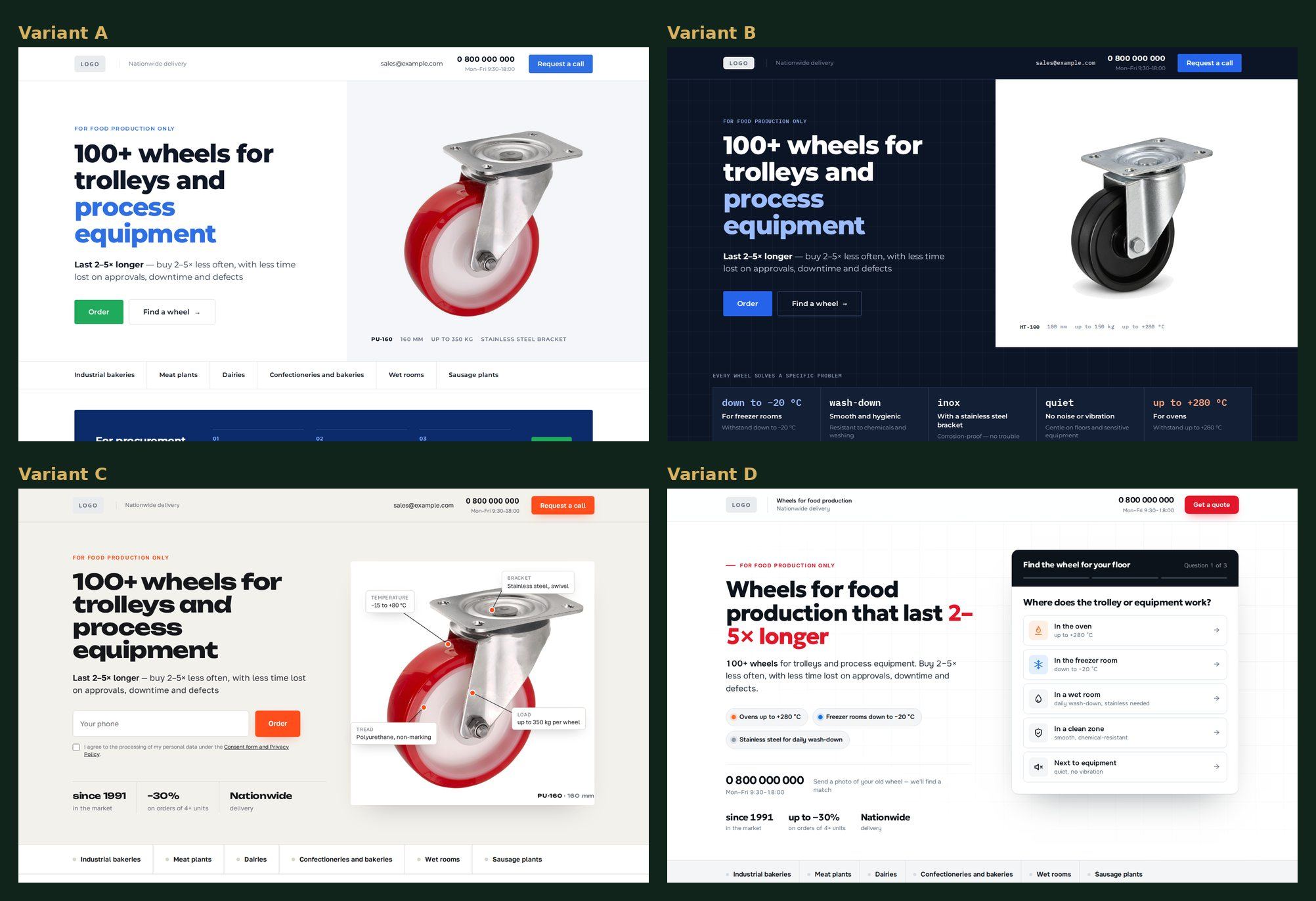
Four pages about the same wheels at the same prices. But each one approaches the buyer from a different side.
Version A
Built in the style of the client's main website. The calm one, so existing customers recognize the company.
Version B
Built around the production floor, not the catalog. It has a "temperature map": here's the oven, here's the freezer, here's the wash-down area, and each zone gets its own wheel. A person from a plant doesn't think in part numbers. They think "my wheels keep burning out in the oven."
Version C
It simply looks different: large type, an orange button, a technical drawing of the wheel with callouts, the phone number right on the first screen. On mobile the order button is always under your thumb.
Version D
Built to get the request. A three-question selector sits right on the first screen: where the trolley runs, what mount, what load. Answer and you get a model with a price for your quantity. Below it is a calculator with a slider: what you spend on cheap wheels that last five times less, and what you spend on the durable ones.
Copy, prices and contacts for all four live in one file. Change a price once and it changes everywhere. The first screen adapts to where the visitor came from: an industrial bakery sees wheels for oven trolleys, a meat plant sees stainless steel, a dairy sees smooth ones that are easy to wash. There are six such segments. And every request shows which page and which segment it came from.
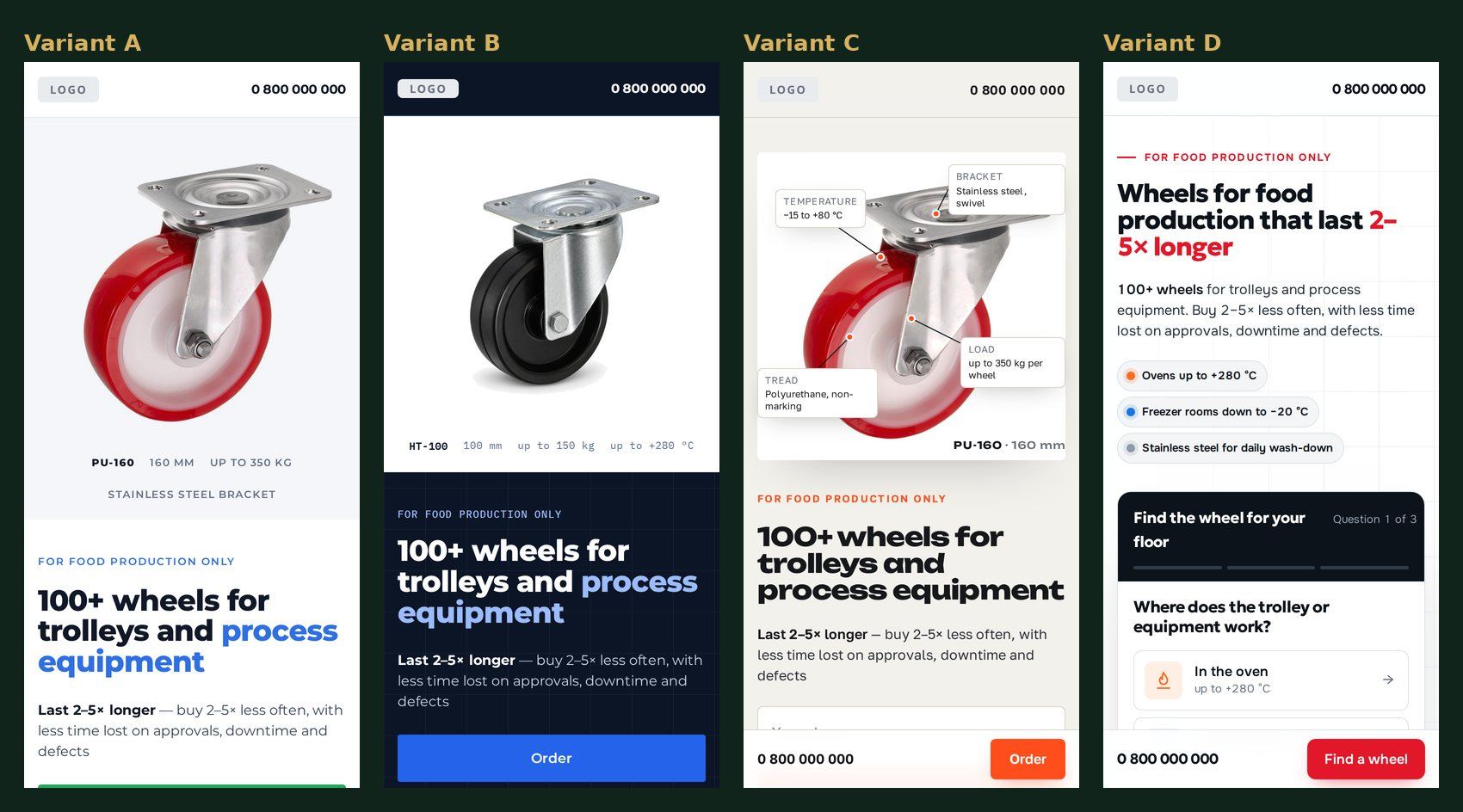
Now about that hour and a half, to be objective. It's a build from a finished brief. I didn't write the concept and the brief, and they took people about a month. With my background in marketing and sales plus AI tools, I produce a comparable concept in four hours of net working time, revisions included. I built three pages in the first sitting and added the fourth three days later. There are no client revisions in that hour and a half: the client is still waiting for the designer and the developer to hand over their landing page.
One more thing. While building, I found errors in the brief that nobody had noticed before me. In eleven product cards the unit price and the price for four or more were swapped, and in one card wholesale came out more expensive than retail. The first screen says the wheels last "2–5 times longer," and further down it's already "3–5 times." That's no dig at the author; every long document has this. But a designer usually isn't deep into marketing and often executes the brief word for word. That's how an error travels all the way to the finished page. My marketing and sales experience lets me catch other people's mistakes fast, before real money goes into ads, not after the first call asking "why is your wholesale price higher?"
What does the usual route cost?
| The usual route | With AI | |
|---|---|---|
| Brief, design, coding | about 2 months, about $1,500 | one day |
| Ad test | 1 month | 1 month |
| Answer on the idea | in about 3 months | in about 1 month |
| Versions in the test | 1 | 2–4 |
The $1,500 is not the main loss. Money can be earned again. Time can't. The main loss is that in two months the client learned nothing about the idea. Not one click, not one request; the ads haven't even been switched on. And once they are, it takes another month to collect the data. That's three months to answer a simple question: will food producers order wheels from a separate landing page at all?
And if the answer turns out to be "no"? Then that "no" costs three months and $1,500. The same answer can be had in one month.
Why four versions at once when one would do?
For the same reason as speed: to stop losing time. Say there's one landing page. The ads ran for a month, requests are few. What didn't work? The idea itself? The offer? The first screen? Nobody knows. So round two begins: designer again, developer again, "by Friday" again. Two more months.
With four pages there is no round two. The ads are split between them, and a month later you have a number instead of an argument. Not "I feel the drawing looks more serious," but how many requests each one brought in. And a version differs in more than the picture. It can carry a different offer, a different first screen, a different way to leave a request.
One caveat. Four pages split the traffic four ways, and on a small budget the data builds up slowly. In that case you test the two most different ones, not all four.
Is it cheaper?
Yes. The reason is simple: the usual way you pay three different people (for the concept and brief, for the design, for the coding), and here you pay one. But not several times cheaper, and I won't promise "ten times."
Building a page now costs next to nothing. Thinking did not get cheaper: what to say on the first screen, which offer to test, which versions to pit against each other, where the AI got it wrong. Time shrank by an order of magnitude. Price didn't.
And that's fine. It's exactly why I say count time, not money. A company that tests an idea in a month gets through about ten in a year. One that takes three months gets through four. On the same budget.
What I don't know yet
Which of the four pages will win. The prototype is with the client, it hasn't gone into ads yet, and I have no conversion numbers. Maybe the plainest one, version A, wins, and the three-question selector I'm happiest with turns out to be something nobody needs. When there's data, I'll write it up.
For now the score is this. An ordinary wheel in food production lasts two to three months. The landing page built the usual way has taken two months and still isn't ready. Four landing pages with AI: an hour and a half.
Is your idea stuck at "we're looking for a designer"?
Tell me what you want to test. I'll look at what can ship in a day and which versions are worth pitting against each other in ads.